
May 27, 2023
Faisalabad Profiling by Directory Pakistan.
Introduction:
Faisalabad is one of Pakistan’s wealthiest cities, the largest industrial hub and second largest city of wider Punjab region. From top, left to right.Clock Tower, Sikh Gurdwara, Satyana Road Flyover, Faisalabad Pindi-Bhattian Interchange,Circuit House Gardens, Faisalabad Canal. Nickname of Faisalabad is The Manchester of Pakistan. Historically one of the first planned cities within British India, it has long since developed into a cosmopolitan metropolis. Faisalabad was restructured into city district status; a devolution promulgated by the 2001 local government ordinance (LGO).The total area of Faisalabad District is 5,856 km2 (2,261 sq mi) while the area controlled by the Faisalabad Development Authority (FDA) is 1,326 km2 (512 sq mi).Faisalabad has grown to become a major industrial and distribution centre because of its central location in the region and connecting roads, rails, and air transportation.It has been referred to as the Manchester of Pakistan”.As of 2013, GDP (PPP) of Faisalabad was estimated as $43 billion and projected to rise to $87 billion in 2025 at a growth rate of 5.7%.Faisalabad contributes over 10 percent to the Punjab’s GDP and has an average annual GDP (nominal) of $20.5 billion.Agriculture and industry remain its hallmark.

History:
The first university in Lyallpur was built by the British Indian Empire in 1906 with the foundation stone laid by Sir Louis Dane, then Lieutenant and Governor of Punjab. Mohammed Ali Jinnah, in Lyallpur where he gave a historic speech at Dhobi Ghat.One of the earlier industrial exhibition at the University of Agriculture, still a major exhibition in the city today, c. 1949 Lady Mountbatten, Vicereine of India, among the Hindu evacuees at the Punjab Scouts Camp,Layallpur during partition of British India Gurudawar Layallpur, a Sikh Gurdwara constructed during the reign of the British Empire in 1911.

Toponymy:
The settlement was established in 1892 during the colonisation of the lower Chenab Valley. This city was settled down by Rai Bahadur Bhavanidas Sikka, because of this work British Government granted jagirs to him. After Partition his descendants settled in India.Now His fourth generations are settled in Mumbai. This city was named in honour of Lieutenant-Governor of the Punjab, Sir James Lyall, for his role in establishing the canal colonisation project.The surname Lyall was joined with the noun pur, meaning city’ in Sanskrit..On 1 September 1977, the Government of Pakistan changed the name of the city from.Lyallpur to Faisalabad (‘City of Faisal’) in honour of King Faisal of Saudi Arabia, who made several financial contributions to Pakistan.
Early Settlements:
The region encompassing modern day Faisalabad district was originally inhabited by a number of forest-dwelling tribes.It is believed these early settlements belonged to the ancient districts of Jhang and Sandalbar, and included the area between Shahdara to Shorekot and Sangla Hill to Toba Tek Singh.The shrine of Baba Noor Shah Wali was erected in the area in the 1600s.At the conclusion of the Second Anglo-Sikh War in 1849, the entire Punjab region became administered as Punjab province, firstly by the East India Company and after 1858 as part of the British Raj.
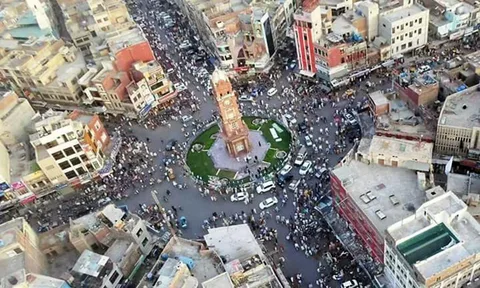
In the 1880s the Punjab government began an irrigation scheme to cultivate large tracts of western Punjab through the creation of canal colonies.The Chenab colony was the largest of these colonisation projects, and covered the entirety of present-day.Faisalabad district. Popham Young, the Colonisation Officer managing the project identified the site of the current city to establish headquarters for the colony.Young designed the settlement’s centre to replicate the design in the Union Jack with eight roads extending from a large clock tower at its epicentre a design geometrically symbolic of the Cross of Saint Andrew counterchanged with the Cross of Saint Patrick, and Saint George’s Cross over all.The eight roads developed into eight separate bazaars (markets) leading to different regions of the Punjab.In 1892, the newly constructed town with its growing agricultural surplus was added to the British rail network.Construction of the rail link between Wazirabad and Lyallpur was completed in 1895.In 1896, Gujranwala, Jhang and Sahiwal comprising the Tehsils of Lyallpur were under the administrative control of the Jhang District.The town became one of the first planned settlements within British India.In 1904, the new district of Lyallpur was created to include the tehsils of Samundri and Toba Tek Singh with a sub-tehsil at Jaranwala, which later became a full tehsil in itself.The University of Agriculture, originally the Punjab Agricultural College and Research Institute, Lyallpur, was established in 1906.The Town Committee was upgraded to a Municipal Committee in 1909. Lyallpur grew into an established agricultural tool and grain centre.By 1911 the city had a population of 19,578.The 1930s brought industrial growth and market expansion to the textile industry as well as to food processing, grain crushing and chemicals.
Independence:
In August 1947, following three decades of nationalist struggles, India and Pakistan achieved independence. The British agreed to partition British India into two sovereign states.Pakistan with a Muslim majority, and India with a Hindu majority; however, more Muslims remained in India than what governing authorities believed would assimilate into Pakistan.The partitioning led to a mass migration of an estimated 10 million people which made it the largest mass migration in human history.The Punjab province was divided into Punjab, West Pakistan and Punjab, India. There were also respective divisions of the British Indian Army, the Indian Civil Service, various administrative services, the central treasury, and the railways.Riots and local fighting followed the expeditious withdrawal of the British, resulting in an estimated one million civilians deaths, particularly in the western region of Punjab.Lyallpur, which was located in the region of the Punjab Province that became West Pakistan, was populated by a number of Hindus and Sikhs who migrated to India, while Muslim refugees from India settled in the district.In 1977, Pakistani authorities changed the name of the city to “Faisalabad” to honourthe close relationship of Faisal of Saudi Arabia with Pakistan.During the eighties, the city realised an increase in foreign investment.More Faisalabadis began workingabroad as bilateral ties improved within the new dominion. This led to more monetaryfunds returning to the city that aided the development of the region.In 1985, the city was upgraded as a division with the districts of Faisalabad, Jhang and Toba Tek Singh.
Geography:
The total area of the District is 5,856 square kilometer. It lies between longitude 73° and 74° East, latitude 30° and 31.5° north, at an elevation of 605 feet above sea level. There is no natural boundary between Faisalabad and the adjoining districts. Faisalabad is bounded by Hafizabad and Sheikhupura towards north and northeast, by Sheikhupura, Okara and Sahiwal towards east and southeast, and by Jhang and Toba Tek Singh towards west and southwest FDA’s notified controlled area is 1,280 sq km River Chenab flows about 30 km in the northwest while River Ravi meanders about 40 km off the city in the southeast. Lower Chenab canal is the main source of irrigation water which meets the requirements of 80% of cultivated land. The soil of Faisalabad comprises alluvial deposits mixed with loess having calcareous characteristics and the soil is generally fertile.
Faisalabad Speciality:
Faisalabad is well recognized for its clothes and related items throughout the world. It is the best market to buy home furnishings (bed sheets, curtains, towels etc.), personal clothing, and hosierywear. The Punjabi dresses are considered as the traditional clothes of Faisalabad
Natural Resources:
Agriculture:
Crops
The major crops of the district are:
• Wheat
• Sugarcane
• Rice
• Jawar
• Moong
• Mash
• Masoor
• Maize
• Oil Seeds
• Rape
• Mustard
• Sunflower
Fruits
The following fruits are grown in this district:
• Citrus
• Guavas
• Mangoes
• Lychee
• Pomegranate
• Jaman
• Peaches
• Dates
• Phalsa
• Banana
Vegetables:
Main vegetables grown in the district are:
• Potatoes
• Carrot
• Cauliflower
• Turnip
• Ladyfinger
• Onion
• Tomato
• Bitter Gourd
• Bottle Gourd
• Peas
• Garlic
• Chilies
Transportation:
Faisalabad is well-connected by rail, road and air. Public transportation in Faisalabad includes auto-rickshaws, buses and railways. Faisalabad International Airport is located on the outskirts of the city and operates flights to the Middle East.
Road:
The majority of roads are under the control of National Highway Authority, linking Faisalabad with other cities in the country.Faisalabad is connected to various parts of the country by several National Highways and Motorways:
• The Grand Trunk Road, otherwise known as GT Road, is the original highway that links Faisalabad to most parts of Pakistan as well as neighboring countries. GT Road was the main highway that ran through the district before the completion of the motorways.
• The M3 Motorway (Pakistan) or M3 is an accesscontrolled motorway connecting Faisalabad with the M2 Motorway (Pakistan) or M2 via the Pindi-Bhattian Interchange. The M2 was the first motorway connecting Rawalpindi and Islamabad to Lahore.
• The M4 Motorway (Pakistan) or M4 is an accesscontrolled motorway connecting Faisalabad to Multan.
The M4 further joined the M5 which connects to the southern city of Sukkur.The district government has worked with the National Highway
Authority to connect Multan and Faisalabad. The M4 was designed to reduce congestion, boost trade, and reduce travel
times and transportation costs from Faisalabad, a major textile hub to the major trade Centre of Multan.
Buses:
The Faisalabad Urban Transport System Service (FUTS) is the main bus operator within the city. It was launched in 1994 and operates a number of large CNG buses and smaller Toyota hiace vans connecting the majority of the city. There is another publicprivate run bus operator, Brothers Metro, which is a consortium between Government of the Punjab and a private firm who
operates a fleet of air-conditioned CNG buses.
Rail:
The Faisalabad railway station is the central railway station in the city. The railway line forms part of the Khanewal-Wazirabad railway line. Rail services are operated by Pakistan Railways,owned and operated by the Ministry of Railways.
Cargo Express services are operated by Pakistan Railwayswhich runs from Karachi to Faisalabad via Multan. The station
has a special cargo facility operated by the Ministry of Railways(Pakistan) for handling various goods from the city to other regions of the country. An express parcel service runs from Karachi to Lahore via Faisalabad
Air Traffic:
Faisalabad International Airport is approximately 15 kilometers(9.3 mi) from the city center and is a major airport for domestic and international travel. The airport includes a cargo facility. As of January 2016, passenger flights are run by the national flag carrier, Pakistan International Airlines, and several Middle Eastern carriers. There are seasonal Hajj flights to Jeddah and Medina operated by Shaheen Air. FlyDubai became the first international carrier to launch operations from the city followed by Qatar Airways, Air Arabia and Gulf Air.In 2015, significant upgrades and renovations to the airport were initiated by the Pakistan Civil Aviation Authority, including updates to aviation technology, construction of additional areas and services for travelers, and the expansion of air traffic capabilities to accommodate wide-body aircraft.

Climate:
The climate of Faisalabad features a semi-arid climate with very hot and humid summers and dry cool winters. The average maximum and minimum temperatures in June are 45.5 °C (113.9 °F) and 26.9 °C (80.4 °F). In January the average minimum and maximum are 19.4 °C (66.9 °F) and 4.1 °C (39.4 °F). The average annual temperature is 26.2°C while precipitation here is average 101mm. The summer season is reasonably longer than the winter season. The summer begins in themonth of April and carries on until the month of October while the winter season starts from November and continues till March. Dust storms are quite common throughout the summer. The average rainfall in this city is about 100 millimeters.
Places to Visit:
Clock Tower:
The Clock Towers one of the oldest monuments still standing in its original state from the period of the British Raj. It was built in the center of the city by filling an old well. The Clock Tower is locally pronounced as “Ghanta Ghar” which means “an hour house” due to the clock installed in it. The erection of this structure was started on 14th November, 1903 by the British lieutenant governor of Punjab, Sir Charles Riwaz and the known local landlord of the Mian family of
Abdullahpur. It is located in the center of the city which is the oldest market of Faisalabad with eight bazaars, that were planned on the design of Union Jack (British Flag) approved by Sir James Broadwood Lyall in 1880 (Governor of Punjab at that time). The Clock Tower was opened for the public by Sir Lewis Tupper, Financial Commissioner of the city on December 13, 1905.
Kaiseri Gate:
Kaiseri Gate was constructed in 1897 in commemoration of the 60th year of the reign of Queen Victoria. It is located at Circular Road and functioning as entrance of one of the old bazaar entrance i.e. Rail Bazar. The entrance itself is made of reinforced concrete and painted pale yellow and light brown to give it a Mughal architecture look. The gate original markings are still viewable at the top with the name and the date of when constructed. The gate is directly in front of the Faisalabad Gumti in the older part of the city. The gate and the Gumti is located on Railway Road, a large market for bathroom furniture and many banks.
Gumti
Gumti is a small structure at circular road constructed in 1897. A statue of Queen Victoria was installed in the center of the Gumti but after some years of independence, it was broken. After that a fountain was installed there. Restoration of Gumti was done by Lyallpur Heritage
Foundation:
Company Bagh:
Company Bagh or Kaiseri Bagh or King Garden was constructed in 1914 by the British Government. In 1990, it was named as Bagh-e-Jinnah. It has huge and beautiful gardens and historic sites like Lyall Monument, fountains etc. Lyall Monument is worth mentioning here and was built as a memorial to Sir. James Lyall, founder of Lyallpur, near 1920. Proper care of this monument was not taken by the management earlier due to which some architectural features of this structure were broken and went missing. Restoration of this monument was started by Lyallpur Heritage Foundation.
Lyallpur Museum:
Lyallpur Museum is a heritage museum in Faisalabad, Pakistan (the old and original name for the city of Faisalabad is Lyallpur). It was established in 2011 by then Chief Minister of Punjab. It has 10 galleries which show the ancient and modern history and culture of Lyallpur / Faisalabad:
• Orientation Gallery
• Sandal Bar Gallery
• Regional Heritage Archaeological Gallery
• Muslim to Sikh Period Gallery
• Chenab Colony Gallery
• Lyallpur Gallery
• Thought and Act Gallery
• Social Beauty Gallery
• Textile Gallery
• Pakistan Movement Gallery
Gatwala Forest Park:
The park is situated 17 km of Faisalabad along Faisalabad to Sheikhupura Road and 120 km from Lahore. The park consists of 131 acres reserved forest and is being managed for recreational purposes. The park was established during 1984-85 to 1991-92 at a total cost of Rs.15.676 million under a development project “Establishment of Forest Park at Gatwala”. This park is a combination of cultural, educational and amusement facilities. The park provided recreational
facilities at economical charges and to educate the public about forests and forest types. Themain objective to establish the park is to create awareness amongst the people regarding importance of Wildlife and its role for mankind. The following facilities are available in Gatwala Forest Park :
• Gazebo
• Children Gadgets
• Grassy Lawn
• Camping Grounds
• Walking Tracks
• Metteled Road
• Lake and Boating
• Wild Life Breeding Center
Important Personalities:
Nusrat Fateh Ali Khan:
Nusrat Fateh Ali Khan, (born on October 13, 1948, in Faisalabad), was a Pakistani singer who is considered one of the greatest performers of qawwali. Nusrat Fateh Ali Khan was arguably among the most blessed and celebrated artists the world has ever witnessed. He was instrumental in redefining qawwali and popularizing it all across the globe. Music was in his blood as he was born in a singing family which owned 600 years of qawwali tradition. He had an extraordinary quality of singing in the high pitch for a long duration and this quality won him numerous accolades. He was often referred as ‘Shehanshah of Qawwalis’ and his name entered the Guinness Book of World Record for releasing the highest number of qawwali albums (125). Nusrat Fateh Ali Khan gave his first public performance at the young age of 16. His talent was evident then and subsequently through his versatility and unmatched talent, he became a renowned artist all across the globe. He gave live performances in over 40 countries and made qawwali famous worldwide. He is also associated with various international bands too. He was contracted by various international music labels like the Virgin Records, EMI, and Real World among others. He won admiration from American audience after performing at Brooklyn Academy of Music in New York in the year 1989. For his contribution to qawwali music, he was conferred with
numerous awards and most notable of them being President of Pakistan’s Award and UNESCO Music Prize among various others.
Arfa Karim
Arfa Karim Randhawa was born on 2nd February 1995 in the city of Faisalabad. In 2004, Arfa passed the MCP test and won the title of “World’s Youngest Microsoft Certified Professional.” She kept the title by 2008. She also received numerous national awards in Pakistan like Fatima Jinnah Gold Medal in the field of Science and Technology, Salam Pakistan Youth Award, President’s Award for Pride of Performance and many more. Arfa was the voice of Pakistan and she had represented the country at many international platforms. The co-founder of Microsoft Bill Gates invited Arfa Karim to his headquarters in the USA. Arfa Karim sadly passed away on the evening of January 14, 2012, due to a severe episode of epileptic seizure damaging her brain tissues permanently. Following that seizure, Arfa also suffered from a cardiac arrest. Arfa envisioned much in the field of health, education, and a separate IT city.
Saeed Ajmal
Saeed Ajmal (born on October 14, 1977) is a Pakistani cricket coach and former cricketer, who played all forms of the game. He is a right-arm off-spin bowler who bats right handed. Regarded as one of the best spinners in the world of his era, Ajmal was ranked at number 1 bowler in ODI and T20 rankings and on number 2 in Tests at various times between
2011 and 2014. At domestic level in Pakistan, he represented Faisalabad with whom he won the 2005 ABN-AMRO Twenty-20 Cup, Khan Research Laboratories and Islamabad. Ajmal made his ODI debut for Pakistan in July 2008 at the age of 30, and a year later played his first test match. He helped Pakistan win the 2009 ICC World T20. He was awarded with the third highest civilian award of Pakistan, Sitara-e-Imtiaz for his excellent services to the national cricket team by
President of Pakistan on March 23, 2015.
Economy:
The Chenab Chowk Chowk monument pays homage to the city’s textile industry.Eight separate markets compose the Ghanta Ghar bazaar where locally grown produce is sold. As of 2015 GDP (PPP) of Faisalabad was estimated at $63 billion and projected to rise to $107 billion in 2025 at a growth rate of 5.7%. Faisalabad contributes over 35% toward Pakistan’s annual GDP and export revenue. The textile and apparel industry is the major industry in Faisalabad. It is also responsible for almost 60-80% of the export revenue of Pakistan.The Faisalabad Chamber of Commerce and Industry (FCCI) and Pakistan Hosiery Manufacturers Association (PHMA) are the regulatory bodies for all textile and apparel
manufacturers in the city. These organizations work closely with the Ministry of Trade.Faisalabad is as an industrial center with industries like processing mills, engineering,industrial goods, textile manufacturing including cotton and silk textiles, super phosphates, apparel and hosiery, industrial chemicals and dyes, pulp and paper, agricultural research and equipment, oil and ghee (clarified butter), and concentrated beverages.
Ghanta Ghar
The Faisalabad clock tower and its eight bazaars (markets) is a major trading zone in the city. The eight markets were designed based on the English flag, Union Jack. Every one of the eight bazaars is known for certain goods.
1. Katchery Bazar is known for its mobile phones and accessories market. It is named for the session courts located adjacent to the street
2. Rail Bazar is famous for its gold and cloth market.
3. Kharkhana Bazaar is known for its spices and herbs.
4. Montgomery Bazaar (also known as Sutar Mandi) is known for yarn and raw cloth
trading.
5. Jhang Bazaar is known for its fish, meat, vegetables and fruits.
6. Bhawana Bazaar has all the commercial and industrial electrical goods.
7. Aminpur Bazaar has some of the oldest books, stationery and interior décor
boutiques.
8. Chiniot Bazaar is known for allopathic and homoeopathic medicinal stores.
Industrial Zones:
Faisalabad Industrial Estate Developement & Management Company (FIEDMC) was established by Federal Government to boost manufacturing in Faisalabad. Its objectives are to promote business and develop new clientele for the city’s factories. It further supports businesses to find suitable land, infrastructure, provision of utilities and dedicated business support services. Value Addition City (VAC) commonly known as Garment city is located at Sahianwala Road, near Khurrianwala. It is home to many garments and apparel factories.
M-3 Industrial City (M-3-IC) comprises 4356 acres of land and Allama Iqbal City (AllC) comprises more than 3300 acres. They house large scale manufacturing companies including textiles, yarn mills, pharmaceuticals, chemicals automotive, and spare parts, etc. Small Industrial Estate (SME) located at Punj Pullian Road houses small to medium sized industries. It was provided by former Prime Minister, Mian Muhammad Nawaz Sharif to provide international grade services to small and medium sized companies atpromotional packages. Faisalabad has received substantial funding from the government of Punjab and the city district government to improve infrastructure and roads to rural areas.In an effort to deal with the energy crisis, the FCCI has been working with private companies to develop renewable energy resources such as solar energy and the construction of dams within the district.[100] CAE, a German-based renewable energy company, has disclosed plans to establish the first solar panel manufacturing facility in Faisalabad, second of its kind in Asia, with intentions of investing upwards of €100 million (Rs 12.9 billion) for its development. Department of Chemistry and Biochemistry, Faculty of Sciences, University of Agriculture. Faisalabad has several research and educational institutions. Faisalabad is considered a regional hub for of research and higher education, specializing in agriculture, medical sciences, chemical sciences, textile universities and economics. There are many public funded institutions that offer scholarships and financing options to lower and middle income households. Many private schools, colleges and universities offer huge range of courses at various levels of education.

Education System:
The education system is administered by the chief executive officer (CEO) of the District Education Authority of Faisalabad. The city district Government is responsible for funding, finances, management and resource allocation for public run institutions. It fallsunder the Ministry of Federal Education and Professional Training and the Minister for
Education:
High ranking institutions Public funded
1. Divisional Public School Faisalabad
2. Divisional Model School & College, Faisalabad
3. University of Agriculture
4. Government College University
5. Nuclear Institute for Agriculture and Biology
6. Government College for Women University
7. University of Engineering & Technology of Lahore
Private funded
1) National Textile University
2) National University of Modern Languages (NUML)
3) NFC Institute of Engineering and Fertilizer Research (NFC-IEFR)
4) University of Faisalabad
5) Beaconhouse School System
6) The City School
7) Roots Ivy School
8) Allied School
9) Punjab Group of Colleges
10)SKANS School of Accountancy
Healthcare:
Healthcare services are provided to the citizens by both public and private sector hospitals. The government–run hospitals are Allied Hospital, District HQ Hospital, Institute of Child Care,PINUM Cancer Hospital, Faisalabad Institute of Cardiology (FIC) and General Hospitals in Ghulam Muhammadabad and Samanabad.There are a number of private hospitals, clinics and laboratories in the city.
Law Enforcement:
Law enforcement in Faisalabad is carried out by the city police, under the command of the city police officer (CPO), an appointment by the provincial government.The office of the CPO is located in the District Courts, Faisalabad. Various police formations include district police, elite police, traffic police, Punjab highway patrolling, investigation branch, and special branch.
Taxation:
Regional Tax Office, Tax House, Faisalabad, a field formation of Federal Board of Revenue, is situated at Jail Road, Faisalabad. It is responsible for monitioring and collection of federal taxes (Income Tax, Sales Tax and Federal Excise Duty) in the vicinity of Faisalabad Division. This office actively engages mass media as well as other institutions to spread awareness about taxation and facilitate voluntary tax compliances.
Sanitation:
The Water and Sanitation Agency (WASA) is a subsidiary of Faisalabad Development Authority (FDA), established on 23 April 1978 under the Development of Cities Act 1976.Estimates in indicate that the WASA provides about 72% of the city’s sewerage services and about 60% of their water services.The existing production capacity of the WASA is 65 million imperial gallons per day (300 million litres per day), almost all of which is drawn from wells located in the old beds of the Chenab River.From the wells, water is pumped to a terminal reservoir located on Sargodha Road.Water is normally supplied for a total of about 8 hours per day to the majority of the city.The Japan International Cooperation Agency (JICA) has provided financial and hardware equipment to help improve the water and sanitation conditions in the city.
Media:
Television and Radio:
The Pakistan Electronic Media Regulatory Authority (PEMRA) is responsible for the regulation and monitoring of electronic media entertainment in the country.Pakistan Television Corporation, is the state-owned regulated television broadcasting network.The government began licensing private broadcasters in 2002.The government of Pakistan installed the first radio transmitters in the city on 15 September 1982.”Radio Pakistan” broadcasts three government regulated FM stations: “Radio Pakistan FM101, Radio Pakistan FM93 and Radio Pakistan Sautul Qur’an Channel FM93.4. FM101 became operational in 2002, FM93 went live in 2010 and FM93.4 Sautul Qur’an Channel went live in 2016; PBC all three stations are standard power KW 2.5.
Telecommunications:
Pakistan Telecommunication Authority is a government-owned organisation that is responsible for the establishment, operation and maintenance of telecommunications in the city.The organisation monitors and prevents illegal exchanges in the city.Pakistan Telecommunication Company Limited is the main provider of fixed line, mobile and broadband services. Regional headquarters is located at the Central Telecom House in Chinot Bazaar.With the deregulation of the telecommunication sector by the Ministry of Information Technology, a range of companies now
offer mobile and broadband services in the city.
Film and Theatre:
In 2008, the Government of Pakistan lifted a forty-year ban on Bollywood films which allowed Indian films to be played in cinemas.The cinema industry has since seen the introduction of new cinemas such as Cinepax by Hotel One and Cine Nagina.The Government College University in Faisalabad encourages students from the University of Agriculture to hold workshops and explore themes of peace and tolerance which can be used in an engaging and entertaining way to communicate complex issues to differentaudiences.
D Ground Central Park was rebuilt by the city district government and now includes miniatures of the symbols of Pakistan such as the Mazar-e-Quaid, Minar-e-Pakistan, and Bab-ePakistan. Iqbal Stadium, is an international cricket ground, home to the Faisalabad Wolves cricket team.
Social Clubs:
The Chenab Club, founded in 1910 is the oldest social club in Faisalabad. It was founded by the British armed forces serving in the area, during the British rule. Today it is a prestigious club offering sports, recreation, dining and cultural activities.
Public Parks:
The Parks and Horticulture Authority (PHA) is responsible for running and managing all public parks within the district of Faisalabad.Jinnah Gardens is the oldest and most established public park in the city. It serves as the city’s central park, and a cultural hub. It is commonly known as “Company Bagh”. A monument of Sir James Broadwood Lyall is situated at the eastern corner of the park. Dhobi Ghat Park is a historic park, in the oldest part of the city. It is located on Kotwali Road, just next to the Government College University, Faisalabad. The park has a long history of rallies and protests. The park was chosen as a venue of choice by Muhammad Ali Jinnah, Liaqat Ali Khan, Huseyn Shaheed Suhrawardy, Zulfiqar Ali Bhutto, Benazir Bhutto, Nawaz Sharif, Shebaz Sharif, Maryam Nawaz and Imran Khan. Gatwala Park is located in the outskirts of the city, on the north-eastern side. It serves as a family park with amusements such as a zoo and a lake. The Gatwala Wildlife Park is a botanical natural reserve located next to the Gatwala Park. It that was renovated by the city district government.Pahari Grounds is located in Peoples Colony #2. It is a residential area popular locations
such as Babar Chowk, Fawara Chowk and the old gates. A Pakistan Air Force retired F-86 Sabre is on display on a hilltop within this park. It is a local attraction. D-Ground Park is located in the Peoples Colony #1 area, within the D-Ground shopping area. Several models of Pakistani monuments are on display in this park, all year round.
Sports:
Main article: List of sports venues in Faisalabad Cricket is a popular sport in Faisalabad. Regional and international cricket matches are held in Iqbal Stadium,named after Pakistani poet Sir Allama Muhammad Iqbal.The stadium is home to Faisalabad’s local team, the Faisalabad Wolves.Iqbal Stadium hosted the 1987 Cricket World Cup,and the 1996 Cricket World Cup.
The Faisalabad Hockey Stadium, located on Susan Road, was constructed in 2002, and can accommodate 25,000 spectators. On 16 April 2003, the stadium was inaugurated by Khalid Maqbool, governor of Punjab. It is the third-largest field hockey stadium in the country.The stadium has hosted field hockey matches for both national and international competition but by the beginning of 2016 was reported to be in “pathetic condition as its astroturf has completed its life span about eight years ago.” Commissioner Naseem Nawaz advised that efforts were under way to maintain the
stadium.In October 2002, the Government College University established a Directorate of Sports to promote university and national level sports for male and female players. Infrastructure and facilities are available for university players in track, hockey, tennis, basketball, table tennis, badminton and cricket pitch.Public libraries and museums.
There are two libraries that are open to the public: Allama Iqbal Library and Municipal Corporation Public Library. They are funded and regulated by the government of Punjab under the service sector.
Allama Iqbal Library is located on University Road, opposite the District Courts. The library is housed in the 1911-built colonial building originally named “Coronation Library” during the rule of the British Empire. In 2012, the building came under control of the Lyallpur Heritage Foundation and the Punjab Archives and Libraries Department.
Lyallpur Museum is located adjacent to the Allama Iqbal Library on University Road. It is a heritage museum and art gallery open to the public. The museum is primarily focused on regional history with a collection of artwork, artefacts and photographs.
Municipal Library is located in Iqbal Park on Narwala Road, opposite the historical grounds of Dhobi Ghat.The library has a large collection of books, a photo gallery and a conference centre. In 2011, the library underwent a renovation costing 40 million rupees.
The Forest Library at the Punjab Forestry Research Institute (PFRI) is one of two specialist libraries, the other being in Lahore.Opened in 1986, the research library is based at the Wildlife Research Center in Gatwala.
Causes Pollution in Faisalabad:
The main causes of pollution in Faisalabad include sources such as emissions from vehicles, with numerous cars, motorbikes and heavy-duty vehicles such as trucks, lorries and buses inhabiting the roads. Many of these run on lower quality fuels, or fossil fuels such as diesel, and often aren’t subject to the same stringent rules that other countries might have in place, leading to huge numbers of ancient and outdated vehicles still being in use, putting out vast amounts of smoke and fumes far beyond the level of what a newer vehicle running on cleaner fuel would do. Other sources are of course the many factories and textile mills around the city, along with brick kilns that number in the thousands, many of which also run on unclean fuel sources and are not subject to any universal regulations. Other industrial areas that further contribute to pollution levels are ones such as chemical plants, foundries and smelting plants, sugar mills and poultry feed production units. Other causes of pollution include the burning of wood and other materials in homes, dust from roadside areas as well as transborder smoke, which can be blown in from other areas and accumulate within the city, being unable to disperse and causing the heavily elevated numbers as seen on record.

Ways to Reduce Air Pollution
OUTDOORS
1. Minimize air pollution from cars
2. Walk, bike or use public transportation
3. Save energy
4. Maintain your wood stove or fireplace
5. Recycle & buy recycled products
6. Consume less & choose sustainable products
7. Eat local, organic produce & less meat
8. Grow your own food
9. Plant trees
10. Raise awareness
INDOORS
1. Keep air-purifying indoor plants
2. Open windows
3. Use natural products
4. Use essential oils
5. Test your home for radon
6. Do not smoke indoors
7. Keep indoor humidity low
8. Vacuum clean with a HEPA filter
9. Clean dust
10. Use air purifiers
Conclusion:
Faisalabad has grown to become a major industrial and distribution centre because of its central location in the region and connecting roads, rails, and air transportation. It has been referred to as the Manchester of Pakistan”. Air is polluted there because of heavy vehicles to overcome from pollution above are the points provided for it , it’s famous for clothes it’s rich in minerals and many other things are provided through out the world from there it’s wealthiest city in Pakistan.
Faisalabad has grown to become a major industrial and distribution centre because of its central location in the region and connecting roads, rails, and air transportation.It has been referred to as the Manchester of Pakistan”.As of 2013, GDP (PPP) of Faisalabad was estimated as $43 billion and projected to rise to $87 billion in 2025 at a growth rate of 5.7%. Faisalabad contributes over 10 percent to the Punjab’s GDP and has an average annual GDP (nominal) of $20.5 billion. Agriculture and industry
remain its hallmark.